November 1, 2026 · 3 min read
Dual-stack networks are the future
We expanded our IPv6 allocation from a /40 to a /36 and run our network dual-stack. An IPv4-only network is a dead end, and NAT64 is the right way to retire IPv4 from client networks.
Our network runs IPv4 and IPv6 side by side, and we think every network should. A network that offers only IPv4 is already behind.
Our position
The registries stopped having new IPv4 space to hand out years ago. ARIN’s free pool ran out in 2015. The IPv4 addresses that exist are now bought on a transfer market or shared behind carrier-grade NAT, and both of those get more expensive and less pleasant every year. IPv6 has no such ceiling.
Too much of the internet is still reachable only over IPv4 to turn it off, so a network has to speak both protocols for as long as that is true.
Dual-stack has real operating costs. You keep two address plans and two sets of firewall rules. Clients fall back from one protocol to the other so quickly that a broken IPv6 path can go unnoticed for weeks. We accept that cost because it is mostly paid once, while the cost of staying on IPv4 alone grows with every address you need.
From a /40 to a /36
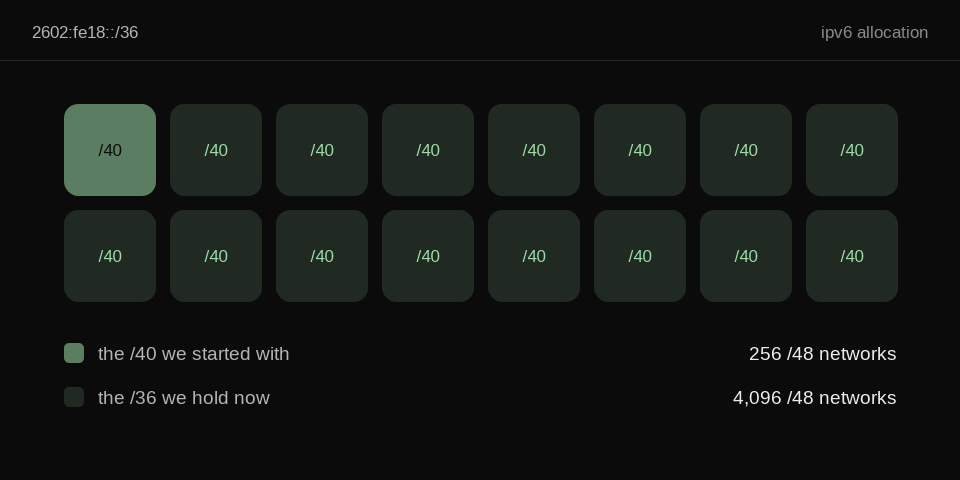
ARIN first allocated us a /40, which is 256 /48 networks. That is enough for a lab, but it was tight for the address plan we wanted, with a /48 for each site and each customer and enough structure that routes and filters stay simple.
We then asked ARIN for a /36, which is sixteen times the size: 4,096 /48 networks. It is what we hold today as 2602:fe18::/36. We requested it to deploy IPv6 across the whole network and run every part of it dual-stack, without having to redo the plan later.
IPv6 was designed so that operators could stop rationing addresses. An address plan built around scarcity carries IPv4’s constraints into a protocol that does not have them.
Where NAT64 fits
Dual-stack is the right default for servers and routers. For networks of clients we think it is worth going a step further and running IPv6 only, with NAT64 as the path to destinations that still have only IPv4.
NAT64 translates between the two protocols at the edge of the network. An IPv6-only client looks up a name. If the name has no IPv6 address, a DNS64 resolver synthesizes one inside the translator’s prefix, usually 64:ff9b::/96, and the translator carries the connection to the IPv4 internet. Software that insists on literal IPv4 addresses is handled by 464XLAT, which adds a small translator on the client.
Several large mobile carriers have run their networks this way for years.
We prefer NAT64 to carrier-grade NAT, which is the other way to stretch IPv4. Both put a stateful translator in the path. With carrier-grade NAT the network stays on IPv4 and the translator is permanent. With NAT64 the network is already on IPv6, the translator only handles traffic to IPv4-only destinations, and it can be removed when that traffic is gone without touching a client.
NAT64 has drawbacks. DNS64 synthesizes records, which conflicts with DNSSEC validation done on the client, and software with hardcoded IPv4 addresses needs 464XLAT to keep working. These problems are well understood, and we would take them over a second layer of IPv4 NAT.
Recommendations
If you run a network, deploy IPv6 now and run it beside IPv4. Give IPv6 the same monitoring and the same firewall policy that IPv4 has, because the usual failure is an IPv6 path that nobody is watching. Where you control the clients, consider IPv6 only with NAT64 before you add more IPv4 NAT.
We announce and route IPv6 address space for other networks as part of our routing service.
- Network
- IPv6