January 22, 2026 · 3 min read
Hosting more game servers on less IPv4 with SRV records
A DNS SRV record lets a name carry a port, so many self-hosted game servers can share one IPv4 address. Minecraft shows how well this works, and a reverse proxy can take it further.
Many people who host a game server for their friends no longer have a public IPv4 address of their own. Home connections increasingly sit behind carrier-grade NAT, and an address of your own costs money every month. The common workaround is to share an address and give each server its own port, and players then have to type the address and port, for example 203.0.113.7:25566.
DNS SRV records remove the need to type a port. They let a name point at a port as well as a host, and we think every game that runs on self-hosted servers should look them up.
How SRV records work
An SRV record is defined in RFC 2782. It is published under a name made of the service, the protocol, and the domain, and it carries a priority, a weight, a port, and a target host.
_minecraft._tcp.alice.example.net. SRV  0 5 25565 game.example.net.
game.example.net.                  A    198.51.100.7
game.example.net.                  AAAA 2001:db8::7
A client that supports SRV looks up the record first, then connects to the target host on the port the record names. The player only ever sees alice.example.net. The target can have both an IPv4 and an IPv6 address, so the same record serves both kinds of player.
Minecraft as an example
Minecraft Java Edition looks up _minecraft._tcp records before it falls back to the default port, 25565. Hosting providers rely on this to put dozens of Minecraft servers on a single IPv4 address, one port each, while every owner gets a name that works with no port attached.
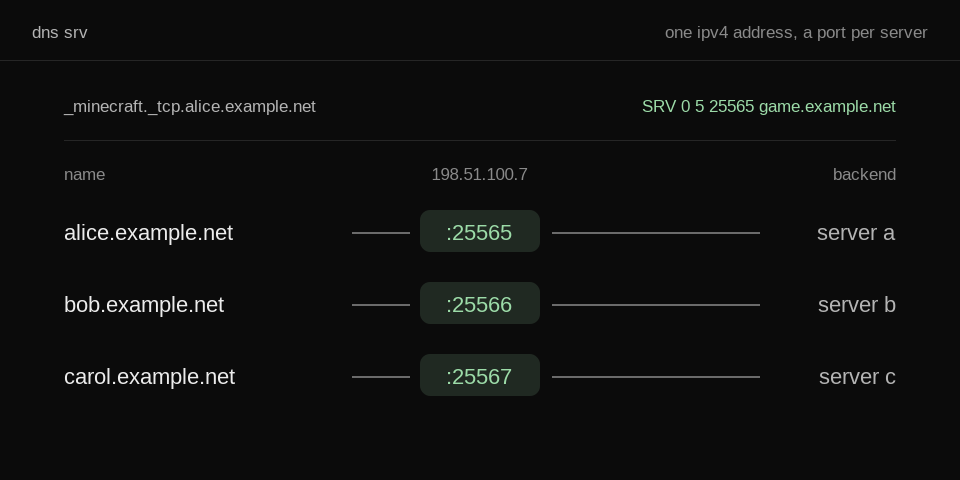
Support is uneven elsewhere. Minecraft Bedrock Edition does not look up SRV records, and many other games ask for an address and a port and nothing more. Games that leave SRV out push their players toward port numbers or toward paying for addresses that are getting scarcer every year.
A reverse proxy on one port
Non-standard ports cause problems of their own. Some networks only allow traffic to well-known ports, and some players will not connect to an unfamiliar one. A reverse proxy solves this by putting every server behind the same port and routing by name.
Minecraft makes this possible because the first packet a client sends, the handshake, includes the server address it connected to. A proxy listening on 25565 reads that address and forwards the connection to the matching backend. Open source routers for Minecraft already work this way.
When a Minecraft client follows an SRV record, the handshake contains the record’s target instead of the name the player typed. Each server therefore needs a target name of its own that points at the proxy, so that the proxy can tell the connections apart.
The proxy also bridges the two protocols. Only the proxy needs an IPv4 address, and the game servers behind it can run on IPv6 alone. One IPv4 address can then front as many servers as the proxy can handle, while the servers themselves use addresses that are not scarce.
What we think providers should do
A hosting provider can serve a large number of game servers this way from very little IPv4 space, and we think it is the right design for game hosting. Each server gets a name and an SRV record, and a proxy on the shared IPv4 address routes connections by name to backends that run on IPv6. The provider no longer spends an IPv4 address on every new server.
If you want to host game servers on our network, email [email protected].
- Network
- DNS